Single-Arm Steering Aids: A Buying Guide for Australian Drivers
Spinner knobs, the OT assessment, NDIS funding, brands, prices, and the Perth installer who did mine. The complete buying guide.
Written by: Alex Osk / One Arm Only
Perspective: Practical lived-experience guide for people using one arm or one hand.
Last updated:
Important: General information only, not medical, legal, driving assessment, prosthetic, or funding advice. For decisions about health, equipment, driving, work, or support, check with a qualified professional or the relevant authority in your area.
If you're driving with one arm and you've never used a steering knob, the first short trip with a properly fitted one feels like cheating. The wheel goes exactly where you want it, you can put your hand back on the gear lever or the indicator stalk without losing control, and parking stops being a workout for your shoulder. The question isn't really whether you should fit one. It's which one, who fits it, and how to pay for it.
This guide walks through the lot. What the different steering aids actually do, which suit one-armed drivers (with or without a prosthesis), how the OT driving assessment works in Australia, what NDIS will and won't cover, the real prices in 2026 AUD, and the specific Perth/WA resources if that's where you are. Read end to end the first time. Skip to whichever section you need on the second read.
Quick orientation: what's a "steering aid" anyway?
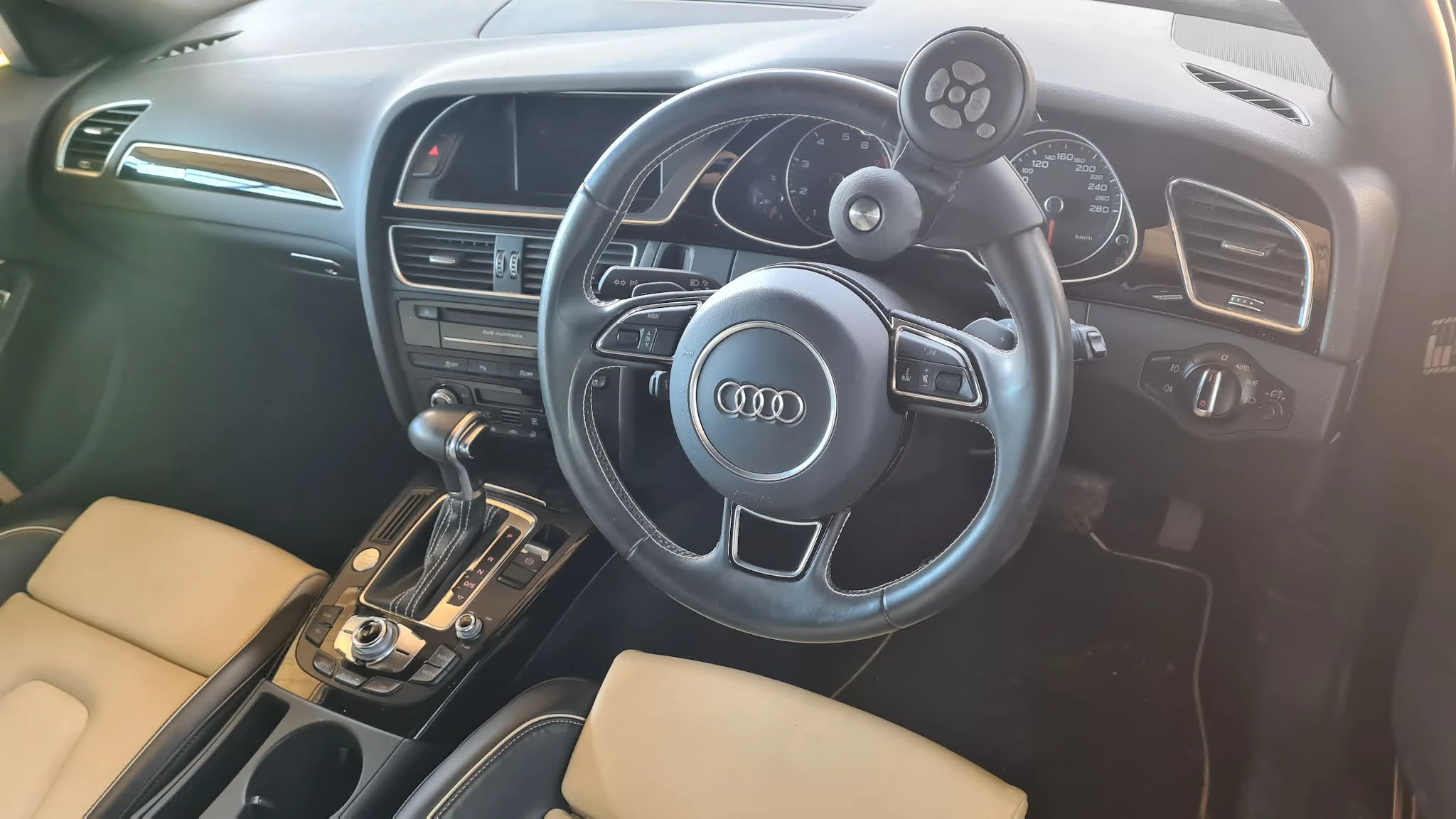
The umbrella term is steering aid. Within that, the most common piece of hardware is a spinner knob: a small free-spinning grip that clamps to the steering wheel. With one mounted, you can keep your hand in one spot and rotate the wheel through full lock without lifting off. There's no hand-over-hand shuffle needed. Older slang names you might still see floating around include "brodie knob", "suicide knob", and "necker's knob". Same thing: the modern disability-aid versions are far better engineered than the chrome 1950s versions those nicknames came from.
Spinner knobs are the most common steering aid for one-armed drivers, but they're not the only option. There are pin-style grips, palm grips, and rings specifically designed to work with prosthetic hooks. Each one fits a different hand or limb situation. Picking the right one is what most of this guide is about.
There's also a separate category of electronic and high-level controls (joysticks, micro-wheels, foot-steered systems, Joysteer 3.0 and similar). These exist for people who can't operate a standard wheel at all. If you're a one-arm driver with a working remaining hand, you almost certainly don't need that category. Standard steering aids will do.
The legal piece, before any of the shopping
This is the part most people skip and then regret. Australian law requires you to notify your state or territory's transport authority of any change in medical condition or surgery that affects your driving, including limb amputation. It's not a suggestion. Driving without notifying can void your insurance.
What happens after you notify is roughly the same across all states, with small admin differences:
- Your GP fills out an "Assessing Fitness to Drive" medical assessment.
- The licensing authority asks you to undertake an Occupational Therapy Driving Assessment (OT-DA).
- The OT-DA recommends what modifications, if any, you need.
- You get fitted, you do some lessons, you pass an on-road test with the modifications.
- You get a conditional licence noting any conditions (must use steering aid, automatic only, etc.).
In WA, the relevant body is the Department of Transport (Driver and Vehicle Services). Their vehicle modification page is at transport.wa.gov.au. You'll deal with them at both the licence-conditions end and the vehicle-modification certification end.
Worth knowing: in some states and territories, a steering wheel aid must be endorsed on your licence. Check with your local transport authority before assuming a knob is just an aftermarket add-on. WA falls in this category for prescribed adaptations.
Types of steering aid (and which suit one-armed drivers)
For a one-armed driver, the choice mostly hinges on whether you have a working hand on the steering side, whether you wear a prosthesis when driving, and how much grip and wrist control that hand or prosthesis has.
Standard spinner knob (ball or contoured)
The classic. A grippable ball or pear-shaped knob that bolts to the wheel and spins freely. Works for anyone with a normal-functioning hand.
Best for: one-armed drivers with full grip in the remaining hand. This is the default starting point and what most one-arm drivers end up with.
Two-point and three-point knobs
A spinner with two or three pins or upright posts that your fingers slot between. Gives more control if you have weakness or stiffness in the hand.
Best for: drivers with reduced grip strength or finger function (for example, partial hand amputation, arthritis, or a stroke-affected hand).
Tri-pin
Three padded pins arranged so your hand and wrist sit between them. Holds your hand in place even if your grip can't. Common when grip strength is minimal.
Best for: drivers with very weak grip or limited wrist stability. Less common for one-arm above-elbow situations because it generally needs an intact hand.
V-grip
A V-shaped cradle that supports the lower hand and wrist. Steers without needing a closed grip.
Best for: moderate grip strength, reduced wrist stability.
Palm grip
A flat or curved pad you press your palm against. Larger contact area, no finger grip required.
Best for: drivers who can't fully close the hand around a knob but have strong enough palm pressure.
Single pin
One vertical post the hand wraps around. Sits between a standard spinner and a palm grip.
Best for: hands that don't open fully, or drivers who want a softer foam grip.
Amputee ring
A stainless-steel or alloy ring sized to accept a prosthetic hook. The prosthesis user clips the hook through the ring and steers from there.
Best for: drivers with an upper-limb prosthesis using a body-powered hook or similar terminal device. Lets you keep the prosthesis on and use it actively for the steering task.
Prosthesis spinner / cup-shaped spinner
A cup or socket designed to receive the residual limb directly, or the rounded end of a prosthesis. The prosthesis or stump goes into the cup; you steer with the upper-arm motion.
Best for: drivers without a hand on the steering side who don't use a hook, or who prefer a passive prosthesis. Total Ability stocks the Fadiel "Prosthesis Spinner" model designed for this.
Custom orthopaedic fittings
Australian outfit Problem Management Engineering (PME) makes one-off custom attachments: driving gloves, custom cups, hand-held devices that interface with their Spinmaster base. Useful when off-the-shelf options don't fit.
How NDIS funding actually works
If you're an NDIS participant, vehicle modifications fall under Assistive Technology. Here's the practical reality:
What the NDIS does fund
NDIS funds vehicle modifications including hand controls and steering aids (spinner knobs, tri-pin), with steering aids generally costing $800–$2,500 installed, and the OT assessment funded separately under Capacity Building at $400–$800. The modification has to be reasonable, necessary, and connected to your disability-related need to drive or travel.
What the NDIS won't fund
The vehicle itself. Convenience features. Anything cosmetic. Major modifications cannot generally be redone within eight years of the previous funded modification, so it's worth getting it right the first time.
Vehicle age and condition rules
If you're planning to modify a second-hand vehicle older than 5 years and no longer under warranty, the NDIS needs a vehicle condition report from a licensed vehicle modifier or certifier. The threshold most providers quote is under 5 years old and under 80,000 km, with exceptions where modifying an older vehicle is genuinely cost-effective and the vehicle has plenty of life left in it.
The paper trail you'll need
In rough order:
- A GP medical "fit to drive" letter referencing the AFTD standards.
- An OT-DA report from a Driver-Trained Occupational Therapist recommending the specific equipment.
- A written quote from a licensed vehicle modifier (the installer).
- A vehicle condition report (if older than 5 years).
- Your existing NDIS plan with capacity in either the Capital (Assistive Technology) or Capacity Building budget.
Plan-managed and agency-managed participants have the installer invoice the NDIS directly. Self-managed participants pay and claim back.
The vehicle has to actually be yours-ish
You or a family member need to own the vehicle, or you need permission in writing from the owner, plus regular use of it. If you're shopping for the car at the same time as planning the mods, do them in that order: pick the car first, get the OT to assess against the car you've actually chosen, then get the modification quote.
Brands and pricing in Australia (2026)
The Australian market has a small number of established suppliers and a handful of imports. Prices below are AUD and exclude installation unless stated.
Total Ability: the main national supplier
totalability.com.au is the exclusive Australian distributor for Fadiel Italiana (Italian brand, made for European-market vehicle adaptations). Based in Artarmon NSW with a national network of installers.
| Product | Price (online) |
|---|---|
| Standard Spinner Knob | $170 |
| Leather Spinner Knob (red / blue / black / white / yellow stitch) | $310 |
| Conical Spinner | quote |
| Two-Point Spinner | quote |
| Three-Point Spinner | quote |
| Prosthesis Spinner | quote |
The "quote" items aren't sold on the open shop. Your OT or installer prices them in for your specific car. Total Ability also publishes a free Complete Guide to Driving With Disability which is worth downloading even if you don't end up buying from them.
Mobility Engineering
mobilityengineering.com.au is a national NDIS-registered provider, partners with BraunAbility, Kivi, and Veigel. Veigel (German) products include the Soft Knob Grip and MyCommand, which is a steering knob plus illuminated button console for indicators, wipers, lights, and horn. MyCommand is the most expensive of the single-knob options because it integrates electronics. Useful when the missing arm side has the indicator stalks.
Gilani Engineering
gilaniengineering.com.au is an Australian NDIS-registered modifier. Sells universal spinner knobs in several grip styles. Will quote per-job rather than publishing fixed prices online for most items.
Problem Management Engineering (PME)
pmeautoconversions.com.au is an Australian specialist that designs and builds custom orthopaedic spinners, driving gloves, and the PME Spinmaster base system. Strong choice if your situation needs something off the shelf doesn't cover.
International: Sure-Grip / MPD (USA)
The most complete catalogue worldwide. Sure-Grip's clamshell base accepts: Standard, V-Grip, Tri-Pin, Single Pin, Palm Grip, and Amputee Ring tops. They also publish a Counter Weight to balance reduced-effort steering systems. Not sold direct in Australia by the manufacturer but commonly imported by Mobility Engineering and others. Imported prices typically run $300–$700 AUD per knob plus base.
Veigel (Germany)
Premium-end European brand. Soft Knob Grip and MyCommand console-knob. Distributed in Australia via Mobility Engineering. Expect premium pricing ($400–$1500+ depending on which model).
What you'll spend in total
For a one-armed driver getting a basic standard spinner knob fitted to a modern car with no other modifications:
| Line item | Typical AUD cost |
|---|---|
| Spinner knob (mid-range) | $170–$400 |
| Installation | $200–$500 |
| OT-DA (clinical + on-road) | $400–$800 |
| Engineering certificate / state inspection | $100–$300 |
| Driving lessons (optional but often recommended) | $100–$200 per hour |
| Realistic total for a simple setup | $1,000–$2,500 |
NDIS will cover the lot if it's reasonable and necessary and you're a participant. Self-funded, you're paying around two grand to be back on the road properly set up.
How to choose: a decision tree that actually works
Walk these in order. Stop when you have an answer.
1. Are you using a prosthesis on the steering side, or steering with the remaining hand?
- Remaining hand → start with a standard spinner knob. 90% of one-arm drivers do this and never need anything else.
- Body-powered prosthesis with hook → amputee ring.
- Cosmetic or rounded-end prosthesis → prosthesis spinner / cup-shape.
- No prosthesis but using residual limb directly → cup-shape or PME custom.
2. Is the remaining hand fully functional?
- Yes → standard ball spinner is fine.
- Reduced grip → two-point or three-point knob.
- Can't close hand fully → palm grip or single pin.
- Minimal grip and weak wrist → V-grip or tri-pin (rare for one-arm cases).
3. Will more than one person drive the car?
If yes, prioritise a quick-release base. Sure-Grip's clamshell and Fadiel's quick-release are both designed to pop the knob off in two seconds so an unmodified driver can use the same wheel. Avoid permanently bolted units unless you genuinely need their extra rigidity.
4. Does your current car have power steering?
It almost certainly does. Power steering has been standard for 25+ years. If you're in something old enough to have unassisted steering, you'll want a slightly larger or two-point grip for the leverage, and you should think about upgrading the car at the same time. Heavy steering and a knob is a tiring combo.
5. Where are the indicators, wipers, and lights?
If your missing-arm side is also the side with most of the stalks (varies by make and country of origin), look at MyCommand or a Lodgesons-style console-knob. Otherwise a standard spinner is fine and you operate stalks with the steering hand briefly while the wheel runs straight.
6. Airbag-equipped wheel?
Every modern wheel has a driver airbag. Quality steering aids are designed not to interfere, but the knob itself should sit in the lower half of the wheel (traditionally at the 8 o'clock or 4 o'clock position) where the airbag deployment path doesn't put your hand in the firing line. Your installer will position it correctly. Worth confirming this is happening, not assuming.
7. What does your OT recommend?
This trumps everything above. The OT-DA is doing the in-car assessment and seeing how you actually move. Their recommendation is grounded in observation, not theory.
The full step-by-step in Australia
Realistic timeline: 8–16 weeks from first GP appointment to legally driving again, depending on OT-DA waiting times and NDIS approval.
Step 1. Notify your transport authority
WA: Department of Transport, Driver Medical Review. transport.wa.gov.au. This is a legal obligation, not optional.
Step 2. GP appointment
Your GP fills in the relevant fitness-to-drive form referencing the AFTD 2022 medical standards. This will cover whether you can drive at all, and trigger the next step if you can.
Step 3. Book an OT Driving Assessment (OT-DA)
You're looking for a Driver-Trained Occupational Therapist. The Occupational Therapy Australia "Find an OT" directory lists them by location. Many OT services across Australia provide both in-home and on-road driving assessments coordinated with local driver-trained instructors.
In Perth, two well-established options are:
- DriverRehab: clinics in Hillarys and East Victoria Park. driverrehab.com.au.
- OT Solutions: national service, also covers WA. otsolutions.net.au.
The assessment itself has two parts:
- Off-road clinical (60–90 mins): vision, cognition, road-rule knowledge, physical assessment, and discussion of what equipment you might need.
- On-road: dual-controlled vehicle with a driving instructor and the OT. Roughly 60 minutes of driving, the rest setup and debrief.
If you don't already drive (you're new to driving, not returning), the same process applies but you'll do learner lessons in adapted vehicles before the test.
Step 4. OT report and equipment recommendation
The OT writes up a report nominating specific equipment, the rationale, and any training requirements. If you're on NDIS, this report is what supports your modification quote.
Step 5. Get an installer's quote
Take the OT recommendations to a licensed vehicle modifier. They quote on the specific knob, mounting hardware, fitting time, engineering inspection, and certification. WA installers worth contacting:
- TADWA (Technology for Ageing & Disability WA): NDIS-registered, MRB8813 licensed, on-site fitting and a mobile maintenance service. Phone 1300 663 243. tadwa.org.au.
- Freedom Motors WA: Troy and Brooke Rowe in Perth. freedommotorsaustralia.com.au/contact-us/wa.
- Empathy Disability Services Perth: also offers vehicle modifications.
Step 6. Submit to NDIS (if applicable)
OT report + installer quote + your existing plan. If you have capacity in your Assistive Technology budget, this can be straightforward. Plan managers and support coordinators handle the paperwork. Approval usually takes a few weeks.
Step 7. Fitting
Modern spinner knobs use clamshell bases that don't damage the wheel. Fitting takes anywhere from 30 minutes (simple knob) to a few hours (combined hand controls package). The installer hands you the receipt and a compliance certificate.
Step 8. Engineering inspection / state certification
Depending on the modification's complexity, the vehicle may need an inspection at an Approved Inspection Station (AIS) or by an authorised modifier. For a basic spinner knob, this is often a quick check. Your installer will tell you if it's needed.
Step 9. Lessons with the new equipment
Even if you've driven for thirty years, half a dozen lessons in your modified car with a driving instructor pay for themselves. New muscle memory takes time, and you don't want the on-road assessment to be the first time you've actually used the knob in traffic.
Step 10. On-road test, conditional licence
The licensing authority issues a conditional licence with whatever conditions the OT and the assessment recommend. Common ones: must use steering aid, automatic transmission only, must wear prosthesis, daylight only (in some cases). Conditions can be reviewed and removed later.
The Perth / WA shortlist
If you're in WA, this is the list to actually call:
| Need | Who to contact |
|---|---|
| OT Driving Assessment | DriverRehab (Hillarys / East Victoria Park) |
| OT Driving Assessment | OT Solutions (national, services WA) |
| Installer / modifier | TADWA · 1300 663 243 |
| Installer / modifier | Freedom Motors WA |
| Equipment supplier | Total Ability (national, ships to WA) |
| Equipment supplier | Mobility Engineering (national, ships to WA) |
| Licensing | DTMI / Department of Transport WA |
| Peer support and advice | Limbs 4 Life |
| Amputee community | Amputees WA |
Limbs 4 Life is the national peak body for amputees in Australia. Their vehicle modifications page is a useful second opinion on this whole process.
Common mistakes worth avoiding
Buying a $20 "spinner knob" off Amazon or eBay. These are decorative accessories meant for utility vehicles in jurisdictions where they're legal without endorsement. Most won't pass an Australian compliance inspection, won't be accepted by your OT, and may invalidate your insurance. Buy from a recognised disability-equipment supplier. Yes, it costs ten times as much. Yes, it's worth it.
Doing the modification before the OT-DA. People sometimes buy and fit a knob, then go for the assessment with it already there. The OT may recommend a different style. You then pay for two installations. Order matters: assessment first, equipment second.
Skipping the lessons. A knob changes how the wheel responds in emergencies, and exactly when you need to react fastest is when old hand-over- hand habits surface and fight you. A few hours of structured practice with a driving instructor sorts that. Also funded under NDIS Capacity Building if you qualify.
Choosing a knob style based on a YouTube video. YouTube reviewers are mostly American, mostly using Sure-Grip products on US vehicles, and mostly not one-arm drivers. Useful for seeing the hardware but not for picking yours. Trust the OT's hands-on recommendation.
Forgetting the conditional licence step. Driving with a steering aid before your licence is updated to permit it is, in most states, the same as driving without a valid licence for that vehicle. Insurance companies will use that as grounds to deny claims.
Not registering the device for warranty. Total Ability and most other suppliers offer warranties but require registration. Five minutes online when the kit's fitted, saves a fight later.
A short word on cost and time, for self-funded drivers
If NDIS isn't an option, there are other paths. Workers' compensation insurers will fund modifications when amputation is work-related (in WA: WorkCover WA). Motor accident schemes cover injuries from vehicle accidents (TAC in VIC, ICWA in WA, etc.). DVA covers veteran-related amputations. Private health extras occasionally cover OT assessments.
As a rule of thumb: budget around $1,500 for a simple setup (knob, install, OT, inspection) and you'll usually come in under it. Add a thousand dollars if you need a more specialised grip or ring. The best-value spend in this whole process isn't the knob, it's the OT-DA. A good Driver-Trained OT will save you from buying the wrong equipment, and the insight from their assessment is worth the appointment fee on its own.
A final practical note
The first knob you fit probably won't be your last knob. Most one-armed drivers trial a standard ball, decide after a few months whether they want a softer grip, a leather finish, or something more supportive, and adjust from there. That's normal. The clamshell-base systems make swapping the top of the knob trivial. Order the new top, click it on, done. You don't need to overthink the first purchase. You just need to start with something safe, properly fitted, and legal.
The thing nobody tells you upfront: getting back behind the wheel one-handed, with the right kit, is less of a comedown than people fear. After a few weeks the knob stops being a mod and starts being just how you drive. The car is yours again, the freedom is back, and most days you'll forget the knob is there at all.
That's the goal.
My install: Freedom Motors WA
I had mine done at Freedom Motors WA in Malaga. Smooth from start to finish. The kit arrived from the supplier and they had it fitted within a day, properly aligned, sitting clear of the airbag deployment zone, and the car back on the road by the next afternoon.
If you're in Perth, they're worth a call.
Freedom Motors WA 19 Kalli St, Malaga WA 6090, Perth freedommotorsaustralia.com.au
Sources and further reading
Australian
- NDIS: Vehicle modifications
- NDIS: Vehicle modifications and driving supports guideline
- Austroads: Assessing Fitness to Drive 2022
- Occupational Therapy Australia: Find an OT directory
- Limbs 4 Life: Vehicle modifications for amputees
- Transport WA: Modifications for people with disability
Suppliers and installers
- Total Ability: Fadiel Italiana, national
- Mobility Engineering: Veigel, BraunAbility, Kivi, national
- Gilani Engineering: universal knobs, NDIS-registered
- Problem Management Engineering: custom orthopaedic
- TADWA: WA installer
- Freedom Motors WA: WA installer
- DriverRehab: Perth OT-DA
- OT Solutions: national OT-DA service
International reference
- Sure-Grip / MPD: US industry-standard product range
- Veigel: German manufacturer
- Amputee Coalition (US): patient resources
Last reviewed: April 2026. Prices are AUD and indicative. Always confirm current pricing with the supplier and check NDIS plan rules with your support coordinator or planner.
Sources and further reading
Use these to check rules, funding, health information, or professional guidance. Local requirements can change and may depend on your situation.
- Austroads: Assessing Fitness to Drive
- National Transport Commission: Assessing Fitness to Drive
- MSD Manual: Options for upper limb prostheses
- NDIS: Prosthetics and orthotics assistive technology assessments
- International Society for Prosthetics and Orthotics: Prosthetics, orthotics and assistive technology
Have your own method?
Share what has worked for you, or ask other one-arm users how they handle this in real life.
Visit the forum